
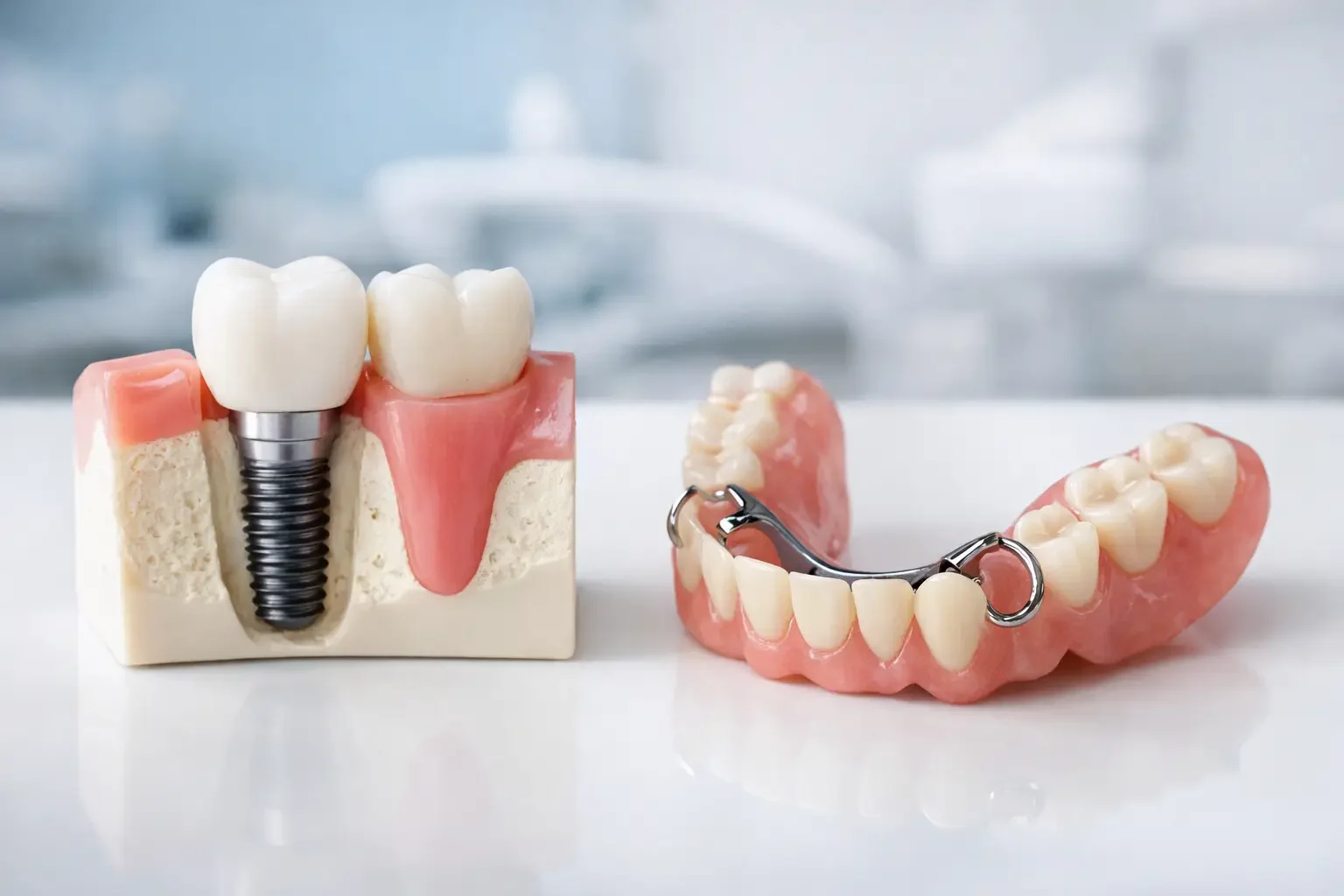
A missing tooth can make everyday moments feel different – ordering your favorite meal, smiling in photos, or speaking without thinking about your teeth. When weighing a dental implant vs partial denture, the right choice is not simply about replacing a space. It is about finding a solution that feels comfortable, supports your oral health, fits your lifestyle, and helps you feel confident again.
Both options can restore the appearance of your smile and make chewing easier. However, they work very differently. A personalized dental evaluation is the best way to understand which treatment will serve you well now and in the years ahead.
What separates an implant from a partial denture?
A dental implant replaces a missing tooth from the root up. A small titanium post is placed in the jawbone, where it gradually bonds with the bone. Once it has healed, a custom crown is attached to the implant. The result is a fixed replacement tooth designed to look, feel, and function much like a natural tooth.
A partial denture is a removable appliance that replaces one or more missing teeth. It is made with artificial teeth attached to an acrylic base or a lightweight metal framework. The appliance rests along the gums and is often supported by nearby natural teeth with clasps or precision attachments.
This difference matters because an implant is secured within the jaw, while a partial denture is removed for cleaning and typically taken out at night. One is a long-term fixed restoration; the other is a practical removable solution.
Dental implant vs partial denture: comfort, function, and appearance
Everyday comfort
Because an implant is fixed in place, many patients say it becomes part of their normal routine after healing. There is no appliance covering the palate, no need to remove it after meals, and no concern about a denture shifting while talking. You brush and floss around an implant much as you would your natural teeth.
A partial denture can also be comfortable when it is carefully designed and properly fitted. Still, it may take time to adjust to the feeling of an appliance against the gums or around neighboring teeth. Some patients experience pressure spots, especially if the fit changes over time. Regular adjustments can help keep the appliance comfortable.
Chewing and speaking
An implant offers stable chewing support because it is anchored in the jawbone. That stability can make a meaningful difference when eating firmer foods, such as apples, meats, or crunchy vegetables. For patients who want the closest experience to having a natural tooth again, this is often one of the strongest benefits.
Partial dentures improve chewing ability compared with leaving a gap, but they do not provide the same level of bite stability. Certain sticky, hard, or very crunchy foods may require extra care. Speaking can also feel slightly different at first, although most patients adapt with practice.
A natural-looking smile
Both treatments can be made to look natural. An implant crown is custom designed to complement the shape, shade, and proportion of your surrounding teeth. It emerges from the gumline like a natural tooth, which can create a highly realistic result.
A partial denture can also restore a full-looking smile, particularly when several teeth are missing. Depending on its design, metal clasps may be visible near certain teeth when you smile. More discreet attachment options may be available in some cases, but suitability depends on your remaining teeth and the denture design.
Bone and long-term oral health
After a tooth is lost, the jawbone in that area can gradually shrink because it is no longer receiving stimulation from a tooth root. An implant helps stimulate the jawbone during chewing, which may help preserve bone in the treatment area.
A partial denture does not replace the tooth root, so it does not provide that same bone stimulation. It can still be a valuable treatment, but it may need adjustment or replacement as gum and bone contours change. The supporting natural teeth also need consistent care because they help hold the appliance in place.
When a dental implant is often the stronger choice
Dental implants are often an excellent option for patients who are missing one tooth or several teeth and want a fixed, durable solution. They may be especially appealing if you value convenience, want to avoid removing an appliance, or are concerned about preserving jawbone around a missing tooth.
Good implant candidates generally have healthy gums, adequate bone support, and a commitment to daily oral hygiene and regular dental visits. If bone volume is limited, additional treatment such as bone grafting may be recommended before implant placement. Medical conditions, smoking, certain medications, and untreated gum disease can also affect planning and healing.
An implant requires a surgical procedure and a healing period, so it is not always the fastest path to a finished tooth. Yet for many patients, the long-term comfort, stability, and appearance make the investment worthwhile.
When a partial denture may make more sense
A partial denture can be a smart solution when several teeth are missing, when a patient wants a non-surgical approach, or when restoring the smile quickly is a priority. It is also often a more budget-conscious starting point than placing individual implants for multiple missing teeth.
For some patients, a partial denture is part of a phased treatment plan. It can restore appearance and basic function while they prepare financially or medically for implants later. It may also be appropriate when bone loss, health factors, or the condition of surrounding teeth makes implant treatment less predictable.
The key is to view a partial denture as a customized medical appliance, not a one-size-fits-all product. A well-planned partial should support your bite, fit your smile, and protect your remaining teeth as effectively as possible.
Cost and timing deserve an honest conversation
The upfront cost of a partial denture is typically lower than the cost of a dental implant. However, the total value of treatment is more than the initial fee. Partial dentures may require future relines, repairs, or replacement as your mouth changes. Implants have a higher initial investment but are designed as a long-term tooth replacement when properly cared for.
Timing also differs. A partial denture may be completed relatively quickly after planning and impressions are taken. Implant treatment can take several months from placement to the final crown, particularly if grafting or additional healing time is needed. In some cases, a temporary tooth replacement can be provided during the process so you do not have to live with a visible gap.
Your dentist should explain expected costs, treatment stages, maintenance needs, and alternatives before you decide. The best recommendation is one that respects both your oral health goals and your practical concerns.
How to choose the right option for your smile
Start with a comprehensive exam that looks beyond the missing tooth itself. Your dentist should evaluate your gums, bone levels, bite, neighboring teeth, medical history, and cosmetic goals. Digital imaging can help determine whether implant placement is appropriate and where it can be positioned for the best function and appearance.
It also helps to think about your daily preferences. Do you want a fixed solution that you care for like a natural tooth? Are you comfortable with a removable appliance? Is a shorter treatment timeline essential, or are you willing to wait for a longer-term result? There is no universal answer, but there is a solution that can fit your needs well.
At United Dental Specialists, personalized treatment planning helps patients understand their options without pressure. Whether you are considering an implant, a partial denture, or a broader restorative plan, the goal is the same: a healthy, functional smile you can feel good about using every day.
A missing tooth does not have to limit what you eat, how you speak, or how openly you smile. A thoughtful consultation can turn uncertainty into a clear plan that supports your health and confidence for years to come.
This article provides general information and does not replace an individual dental evaluation. Options, suitability, costs and outcomes vary by patient. Please consult our team before making decisions about your treatment.
← Back to home
Leave a comment.
Your email address will not be published. Required fields are marked with *.