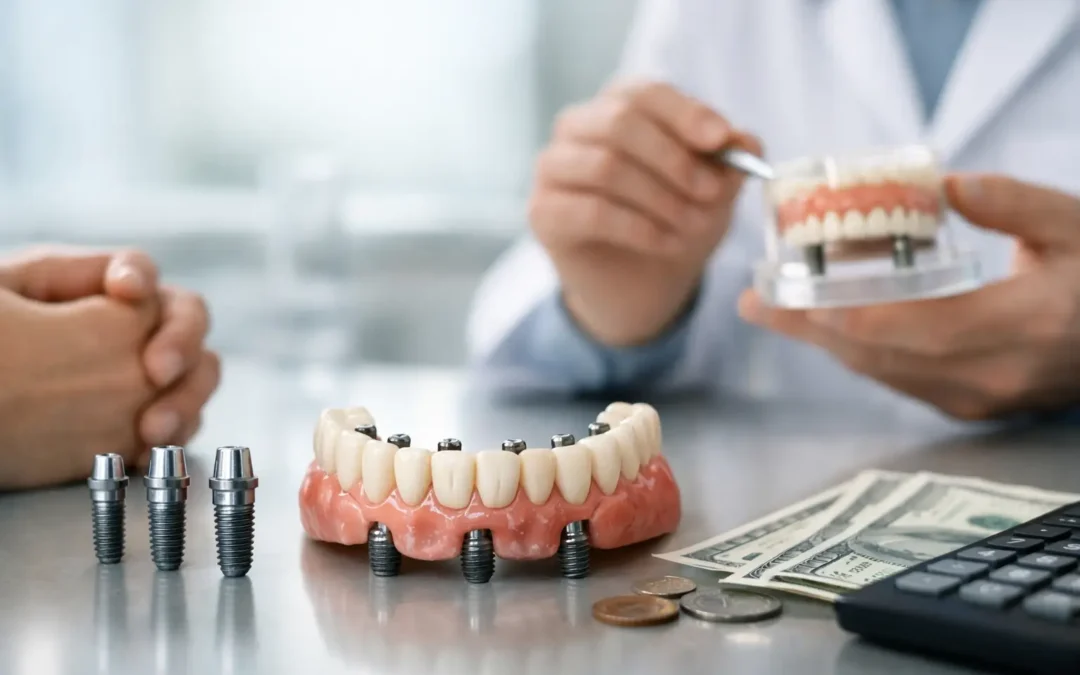
If you have several failing or missing upper teeth, price is usually one of the first questions you ask – and for good reason. Full top arch dental implants cost can vary widely, and the difference often comes down to more than just the implants themselves. The materials used, the condition of your bone, the number of visits, sedation, imaging, and the type of final teeth all play a role in the total investment.
For many patients, the upper arch is also a little more complex than it first appears. Bone quality in the upper jaw is often softer than in the lower jaw, and some people need extra planning before treatment can move forward. That does not mean full-arch implants are out of reach. It means the best estimate comes from a real exam, clear imaging, and a treatment plan built around your mouth rather than a one-size-fits-all quote.
What is included in full top arch dental implants cost?
When people hear one price online, they often assume it covers everything from start to finish. Sometimes it does. Often, it does not.
A full top arch implant case may include the consultation, digital scans, extractions of remaining damaged teeth, temporary teeth, implant placement, sedation, follow-up visits, and the final fixed prosthesis. In other offices, those services are priced separately. That is why two estimates that sound similar at first can end up being very different once you look closely.
The final teeth also matter. A temporary arch is not the same as a long-term final restoration. Some final prosthetics use acrylic over a supportive frame, while others use stronger and more aesthetic materials such as zirconia. The more durable and natural-looking the final result, the more the overall investment can increase.
Typical price range for a full upper arch
In the US, full top arch dental implants cost often falls somewhere between $20,000 and $40,000 or more for one arch. That is a broad range because treatment can be relatively straightforward for one patient and significantly more involved for another.
A case on the lower end may involve fewer extra procedures, a simpler surgical plan, and a less expensive final prosthesis. A case on the higher end may include complex extractions, bone grafting, sinus-related considerations, higher-end restorative materials, or additional implant support.
If you see a very low advertised number, ask what is actually included. Some promotions cover only a portion of treatment, such as implant placement, but not the temporary bridge, final teeth, sedation, or imaging. A lower starting price is not necessarily a bad sign, but it should be explained clearly.
Why upper arch implant treatment can cost more
The upper jaw presents its own planning challenges. Compared with the lower jaw, the bone in the upper arch can be less dense, which may affect implant stability and the surgical approach. The location of the sinus also matters. In some patients, reduced bone volume in the back of the upper jaw limits where implants can be placed or whether grafting is needed.
That does not mean every upper arch case is complicated. Many patients are candidates for efficient full-arch solutions such as All-on-4 or related concepts that strategically place implants to support a full fixed set of teeth. But the upper arch still requires careful imaging and experience, and those factors are part of the value you are paying for.
The biggest factors that affect cost
The number of implants used is one major factor. Some full-arch cases are supported by four implants, while others may use five or six for added support depending on anatomy and treatment goals. More implants usually means a higher fee, but it can also create a stronger foundation in the right case.
The condition of your existing teeth and bone matters just as much. If damaged teeth need to be removed, if infection is present, or if grafting is needed to improve support, the fee can increase. Sedation can also affect the price, especially for patients who want a more comfortable surgical experience.
Then there is the restoration itself. A well-made final arch is a custom medical device, not an off-the-shelf appliance. It is designed to fit your bite, support speech, restore chewing function, and improve the appearance of your smile. More advanced materials and lab work generally raise the cost, but they may also improve longevity and aesthetics.
Full top arch dental implants cost vs dentures
Traditional dentures usually cost much less upfront than a full-arch implant solution. For patients comparing immediate expenses only, dentures can look like the clear winner.
But the comparison changes when you think beyond the first payment. Dentures can shift, rub, limit chewing power, and require ongoing adjustments or replacement over time. They also do not stimulate the jawbone the way implants do. Implant-supported teeth are fixed in place, feel more secure, and often provide a more natural day-to-day experience.
That is why many patients see full-arch implants as a long-term quality-of-life decision, not just a dental purchase. The higher initial cost can make sense when the goal is better stability, confidence, and function.
How to compare quotes the right way
If you are meeting with more than one provider, compare the plan line by line instead of looking at the bottom number alone. Ask whether the quote includes the consultation, CBCT scan, extractions, sedation, temporary teeth, healing visits, and the final prosthesis. Ask what happens if additional treatment is needed after surgery.
It is also wise to ask who is planning and delivering each phase of care. Full-arch implant treatment depends on diagnostics, surgical precision, and restorative design working together. A lower fee may not feel like a bargain if it leaves out important steps or results in compromises you notice every day when you eat or smile.
Experience, technology, and communication matter here. You want a team that explains your options clearly, sets realistic expectations, and builds a plan around function as well as appearance.
Does insurance help with the cost?
Dental insurance may help with certain parts of treatment, but it rarely covers the entire cost of a full upper arch implant case. Some plans contribute to extractions, imaging, or parts of the prosthetic process. Others provide limited implant benefits or annual maximums that cover only a small portion of the total fee.
Because benefits vary so much, it helps to get a detailed breakdown before treatment starts. Financing is also common for full-arch implant care. Monthly payment options can make a larger treatment plan more manageable, especially for patients who want to move forward now rather than delay care while the condition worsens.
Is the cheapest option worth it?
Sometimes a lower-cost plan is perfectly reasonable. Other times, it reflects shortcuts in materials, planning, follow-up care, or final restoration quality. The goal is not to find the most expensive option or the cheapest one. It is to find a treatment plan that is appropriate, transparent, and built to last.
If you are considering full-arch implants, ask about the expected lifespan of the final teeth, how maintenance works, and what happens if repairs are needed later. Those questions can tell you a lot about the true value of the treatment.
For patients in Doral, Miami Lakes, and the surrounding area, a personalized consultation is the fastest way to get a real answer on cost. At United Dental Specialists, patients can learn what is driving their estimate, what options may reduce complexity, and which solution best supports comfort, appearance, and long-term oral health.
What to expect at your consultation
A good consultation should leave you with more clarity, not more confusion. You should understand whether you are a candidate for full-arch implants, what type of restoration is being recommended, how long treatment may take, and what your total cost includes.
You should also feel comfortable discussing your budget. That conversation matters. In many cases, there is more than one clinical path to a healthy and confident smile. One option may prioritize premium materials and long-term durability, while another may focus on balancing function, appearance, and affordability.
The best plan is the one that fits your needs and is explained honestly. If your upper teeth are failing, loose, or missing, getting answers now can help you avoid ongoing discomfort and repeated short-term fixes. A clear evaluation gives you something more useful than a generic online price – it gives you a real plan forward.

Recent Comments