
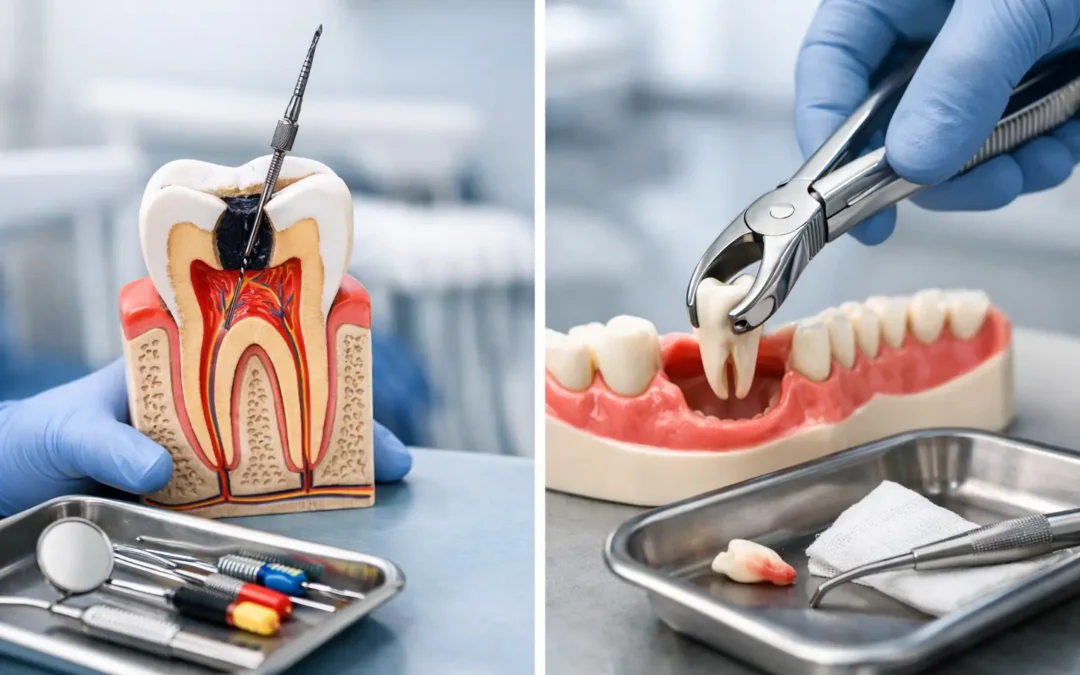
A tooth that throbs when you bite, keeps you up at night, or flares up with hot coffee usually leaves you with one urgent question – can this tooth be saved, or does it need to come out? When patients ask about root canal vs extraction options, they are usually balancing pain, cost, timing, and long-term health all at once.
The right answer depends on the tooth, the level of damage, your overall oral health, and what happens after treatment. In many cases, saving a natural tooth is the better path. In others, removing the tooth and replacing it may be the more predictable choice. What matters most is getting a clear diagnosis and a treatment plan that protects both your comfort now and your smile later.
Root canal vs extraction options: what each one means
A root canal is designed to save a tooth that has infected or inflamed pulp inside. During treatment, the damaged tissue is removed, the inside of the tooth is cleaned and sealed, and the tooth is usually restored with a filling or crown. The goal is simple – eliminate infection while keeping your natural tooth in place.
An extraction removes the tooth entirely. This may be necessary when a tooth is too broken down, split below the gumline, severely loose from bone loss, or damaged in a way that makes long-term repair unrealistic. Extraction can stop pain and infection, but it also creates a gap that often needs to be addressed with a dental implant, bridge, or another replacement option.
That distinction matters more than many patients realize. One treatment preserves what you already have. The other starts a replacement process.
Why saving the tooth is often the first choice
Whenever a tooth can be predictably saved, most dentists prefer that route. Natural teeth help maintain normal bite force, support jaw alignment, and keep chewing comfortable and efficient. Even the best tooth replacement is still a replacement.
A successful root canal can let you keep your own tooth for many years, especially when the tooth is restored properly and maintained with regular care. For patients who want the most conservative option, this is often appealing. You keep the tooth, avoid an empty space, and usually return to normal function quickly.
There is also a cosmetic advantage in many cases. If the treated tooth is restored with a well-made crown, the result can look natural and blend into your smile. For image-conscious adults, that can be a major benefit.
Still, saving a tooth is not always the right answer just because it is possible. The condition of the tooth structure around the infection is what guides the decision.
When extraction may be the better option
Some teeth are simply too compromised to deliver a reliable long-term result. If most of the visible tooth is gone, if decay extends deep below the gums, or if the tooth has a vertical fracture, a root canal may not solve the real problem. You might remove the infection, but still be left with a tooth that cannot hold a restoration well.
Extraction can also make sense when gum disease has severely reduced bone support, or when repeated treatment has already failed. In these situations, removing the tooth may spare you additional discomfort, added expense, and more time spent trying to rescue a tooth with a poor prognosis.
For some patients, extraction is also part of a bigger restorative plan. If a damaged tooth is being replaced with an implant, and the surrounding bite and bone support make that option more stable long term, removing the tooth may be the smartest move rather than the most aggressive one.
Pain, timing, and recovery
Many patients assume a root canal is the more painful option. In reality, modern root canal treatment is typically done with local anesthesia and is often no more uncomfortable than getting a filling. In fact, most people seek treatment because the tooth is already painful, and the procedure is what relieves that pain.
An extraction can also be straightforward, especially for a tooth that is accessible and not impacted. But recovery is often more noticeable afterward because the body is healing an open socket where the tooth used to be. Soreness, swelling, and temporary chewing limitations are common.
The next question is usually timing. A root canal may require the procedure itself plus a final crown if the tooth needs extra protection. An extraction may feel faster at first, but if you plan to replace the tooth, that timeline becomes longer. Implant treatment, for example, can involve healing periods and multiple appointments.
So if you compare root canal vs extraction options only by the first visit, extraction may look simpler. If you compare the full treatment journey, saving the tooth is often less disruptive.
The cost question patients really want answered
Patients are right to ask about cost, but the fair comparison is not root canal versus extraction alone. It is root canal plus restoration versus extraction plus replacement.
A root canal usually needs a crown on a back tooth to protect it from fracture. That adds to the total cost. But extraction often leads to additional treatment if you do not want a missing tooth, and most patients do not. A dental implant, abutment, and crown can cost significantly more than saving the tooth in the first place. A bridge may be another option, but it has its own maintenance needs and may involve neighboring teeth.
If the extracted tooth is not replaced, there can still be a cost over time. Nearby teeth may drift. Opposing teeth may move. Bite changes can create uneven wear or make chewing less comfortable. What starts as a one-time fix can lead to larger restorative needs later.
This is why a personalized exam matters. The least expensive option today is not always the most cost-effective option over the next five or ten years.
Function, appearance, and long-term health
Your decision should not be based on pain relief alone. It should also reflect how you want your mouth to function in daily life.
Keeping a natural tooth usually helps preserve normal chewing and bite balance. That matters whether you are speaking in meetings, eating with family, or simply trying to avoid dental problems that snowball over time. Root canal treatment supports that goal when the tooth is structurally restorable.
Extraction has a different long-term consideration: bone loss. Once a tooth is removed, the jawbone in that area can begin to shrink over time because it no longer receives stimulation from the tooth root. That can affect facial support, neighboring teeth, and future replacement planning. Dental implants help address this by replacing the root function, which is one reason they are often the preferred replacement after extraction.
Aesthetics matter too. In visible areas of the smile, the urgency to replace an extracted tooth is often much higher. In those cases, treatment planning should consider both health and appearance from the start, not as an afterthought.
How dentists decide between root canal and extraction
The decision comes down to a few practical questions. Is the infection treatable? Is there enough healthy tooth left to restore? Is the bone support strong enough? Is there a crack that makes the tooth unreliable? And what does the patient want in terms of timeline, investment, and long-term goals?
X-rays, an exam, and sometimes additional imaging help answer these questions. What patients often describe as a simple cavity or toothache can turn out to be a deep infection, hidden fracture, or advanced structural damage. That is why guessing is risky, especially when pain comes and goes.
At a comprehensive practice like United Dental Specialists, this evaluation can also include what comes next if the tooth cannot be saved. That matters because treatment should not stop at removing pain. It should restore stability, comfort, and confidence.
The best option depends on the whole picture
If the tooth has a strong foundation and can be restored well, a root canal is often the best way to preserve your smile. If the tooth is beyond repair, extraction may be the healthier and more predictable choice, especially when paired with a well-planned replacement.
Neither option is automatically better in every case. The better option is the one that resolves the problem fully, protects your long-term oral health, and fits your needs without leaving bigger issues behind.
If you are dealing with tooth pain, swelling, or a damaged tooth, do not wait for the problem to decide for you. The earlier you get it evaluated, the more treatment choices you usually have – and the easier it is to move forward with confidence.

Recent Comments