
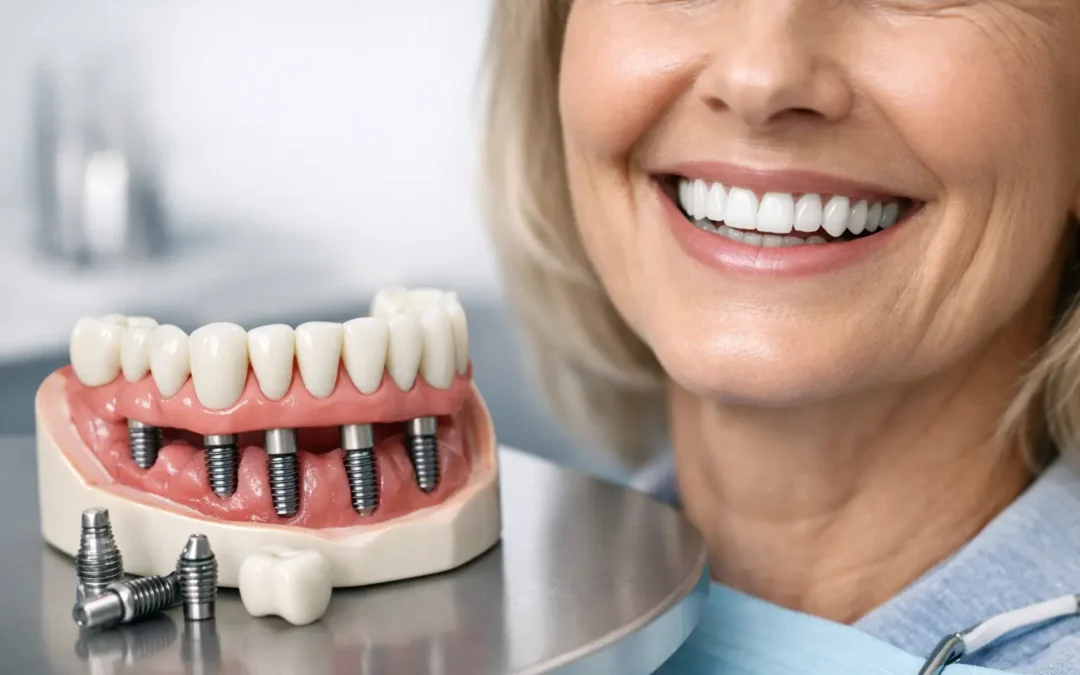
If you are tired of loose dentures, missing teeth, or avoiding certain foods because chewing has become difficult, this guide to full mouth implants is for you. Full mouth implant treatment can rebuild more than your smile. It can restore day-to-day comfort, improve how you speak and eat, and help you feel like yourself again.
For many patients, the hardest part is not the treatment itself. It is figuring out what full mouth implants actually mean, whether they are worth it, and how to know if they are the right choice. The answer depends on your oral health, your goals, your timeline, and your budget. What matters most is understanding your options clearly before you commit.
What full mouth implants really are
Full mouth implants replace most or all of the teeth in the upper arch, lower arch, or both using dental implants as the foundation. Instead of relying on adhesives or removable appliances alone, this approach anchors a full set of replacement teeth to implants placed in the jawbone.
You may hear terms like All-on-4, implant-supported dentures, or full arch restoration. These are related, but they are not always identical. In general, full mouth implants use a small number of strategically placed implants to support a complete row of teeth. Some restorations are fixed in place and only removed by a dentist. Others are removable by the patient for cleaning.
That distinction matters. A fixed solution often feels more natural and stable, but it may involve a different investment and treatment plan than a removable implant-supported denture. A consultation is where those details get sorted out.
A guide to full mouth implants and your options
There is no one-size-fits-all version of full mouth implant treatment. The right solution depends on bone support, gum health, medical history, and what you want your new smile to feel like.
Fixed full arch implants
This option attaches a non-removable set of teeth to a set number of implants. Patients often choose it because it offers strong bite support and a more natural feel. It can be an excellent fit for people who want the closest experience to having natural teeth again.
The trade-off is that fixed restorations usually require careful planning and a higher upfront investment. Good daily home care and regular maintenance visits are also essential.
Implant-supported dentures
These dentures snap onto implants for better retention than traditional dentures. They are more secure than removable dentures that sit on the gums alone, but they can still be taken out for cleaning.
For some patients, this is a practical middle ground. It improves stability and comfort without committing to a fully fixed restoration. It may also be a smart option when budget is a major concern.
Immediate load solutions such as All-on-4
In some cases, patients can receive implants and a temporary set of teeth in a shorter time frame. This approach is appealing because it reduces the time spent without teeth and allows patients to leave with a more complete smile sooner.
Still, not everyone is a candidate for immediate placement and immediate function. Bone quality, bite forces, and overall health all play a role in whether this is appropriate.
Who is a good candidate?
Many adults who have lost most or all of their teeth, or who are facing widespread dental damage, can be candidates for full mouth implants. Patients often consider this treatment after years of dental problems, failing bridgework, advanced decay, gum disease, or frustration with dentures.
A healthy mouth is the goal, but you do not need a perfect starting point. In fact, many patients need preparatory treatment before implants, such as extractions, periodontal care, or bone grafting. What matters is whether the mouth can be brought to a stable condition that supports long-term results.
General health matters too. Conditions like uncontrolled diabetes, smoking, certain medications, and healing disorders can affect implant success. That does not always rule treatment out, but it may change the plan or the timeline.
What the process usually looks like
One reason patients delay care is that they imagine a long, confusing process. In reality, a well-run implant plan is structured and predictable.
It starts with a comprehensive consultation. This visit typically includes digital imaging, an exam, and a conversation about what you want to change. Some patients are focused on chewing comfortably again. Others care just as much about how their smile looks in photos or at work. Both matter.
From there, the treatment plan is built around your needs. If any teeth need to be removed or if the gums need treatment first, those steps happen before or alongside implant placement. The implants are then placed in the jawbone, where they begin to integrate with the bone over time.
Depending on the case, you may receive temporary teeth while healing takes place. Once the implants have fused properly and the tissues are ready, the final restoration is designed and attached. That final set is shaped for fit, bite, appearance, and long-term function.
What recovery feels like
Most patients are surprised that recovery is manageable. Some soreness, swelling, and dietary restrictions are normal in the early phase, especially after extractions or implant surgery. You should expect a healing period, not an instant return to everything you normally eat.
That said, the experience varies. A patient receiving a few strategically placed implants with a temporary restoration may recover differently than someone who needs bone grafting or more extensive surgical work. Following instructions closely makes a major difference in comfort and healing.
Soft foods are usually part of the process for a while. This can feel inconvenient, but it protects the implants while they stabilize. Rushing back to hard or crunchy foods too soon can compromise the outcome.
Cost, value, and what patients should weigh
A true guide to full mouth implants has to address cost honestly. Full mouth implant treatment is a significant investment, and the price varies based on the number of implants, the type of restoration, whether extractions or grafting are needed, and the complexity of the case.
It is tempting to compare prices alone, but that can be misleading. Lower fees may reflect differences in materials, planning, technology, or follow-up care. With full mouth reconstruction, long-term value matters more than a bargain headline.
Patients should also think beyond the initial number. Traditional dentures may seem less expensive at first, but they can come with recurring adjustments, relines, adhesives, instability, and ongoing frustration. For many people, the value of implants is tied to quality of life – eating better, speaking confidently, and not worrying that teeth will shift at the wrong moment.
Questions to ask before saying yes
Before moving forward, ask how many implants are being recommended and why. Ask whether your restoration will be fixed or removable. Ask what kind of temporary teeth you will have during healing, how long the process may take, and what maintenance will be needed after treatment is complete.
You should also ask about your candidacy in plain language. If bone loss, gum health, or medical conditions affect your options, your dental team should explain that clearly. A good consultation should leave you informed, not pressured.
In a practice that focuses on personalized care, the treatment plan should match your goals rather than force you into a standard package. That is especially important with full mouth implants, because the best result is not just clinical success. It is comfort, confidence, and a smile that fits your life.
Life after full mouth implants
Once treatment is complete, patients often describe a sense of relief as much as excitement. Meals feel easier. Speech feels more natural. Smiling becomes less of a decision and more of a habit.
Full mouth implants still require care. You will need regular dental visits, excellent oral hygiene, and attention to any grinding or bite issues. Implants are not maintenance-free. They are, however, designed to give you a much stronger foundation than living with failing teeth or unstable dentures.
For patients in Doral, Miami Lakes, and the surrounding area, working with an experienced team can make the process feel far more approachable. At United Dental Specialists, treatment planning is centered on both health and confidence, so patients can move forward with a clear understanding of what to expect.
If you have been putting off treatment because the idea feels overwhelming, start with the conversation. The right plan should make your next step feel simpler, not harder.

Recent Comments